Independent Portfolio Analysis
Product Affinity Analysis for Cross-Sell & Merchandising
Retail & Ecommerce Analytics
Shopping-basket data was analyzed to identify products customers frequently purchased together, revealing opportunities for cross-selling, product recommendations, merchandising, and commercial experimentation.
The Business Question
Knowing which products sell is useful. Another commercially important question is: “What do customers tend to buy together?” The project explored whether transaction data could reveal meaningful product relationships to support cross-selling, ecommerce recommendations, product bundles, merchandising, promotional targeting, and basket growth.
What I Analyzed
Grocery transaction data showed products purchased together within individual shopping baskets. The data was cleaned and standardized before product combinations were compared. The analysis looked beyond simple frequency to consider whether relationships were stronger than would normally be expected by chance.
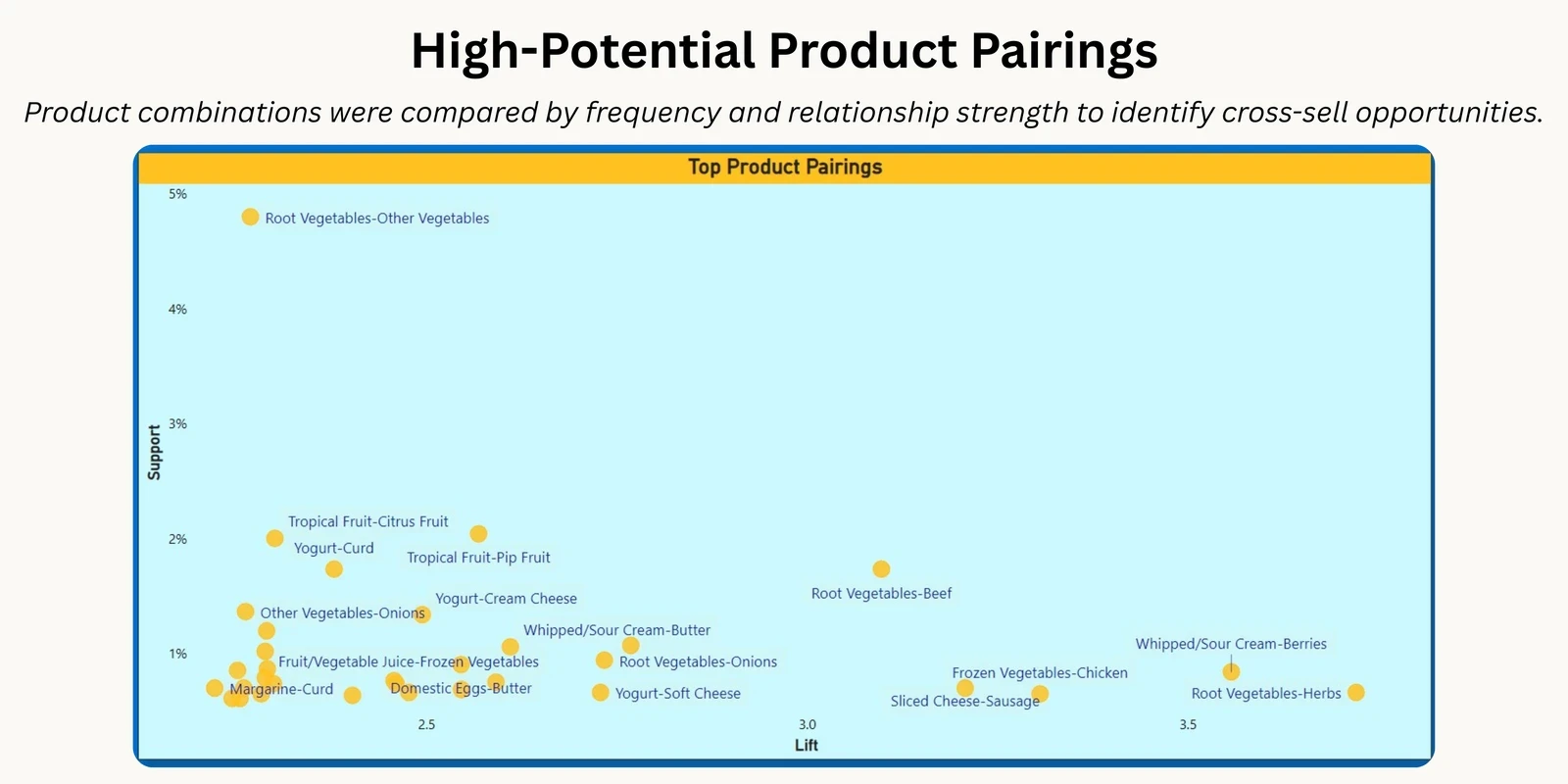
High-Potential Product Pairings
Key Findings
Several product combinations showed meaningful purchasing relationships, including root vegetables and other vegetables, whipped/sour cream and root vegetables, and yogurt and soft cheese. The important insight is that transaction data can reveal product affinities that are not obvious from looking at individual product sales alone.
What This Means for the Business
Cross-selling: use strong affinities as candidates for contextual ecommerce recommendations—“Customers buying this product may also be interested in…”—or CRM recommendations based on previous purchases. Merchandising: investigate associated-product placement in stores, related-product modules, cart recommendations, category recommendations, and checkout cross-sells online. Bundling: treat associated products as candidates for bundle testing, not proof that bundles will increase revenue. Promotions: test contextual offers rather than only broad discounts, such as purchasing Product A leading to an offer for complementary Product B.

Product Relationship Network
Recommended Actions
Potential commercial experiments include frequently-bought-together recommendations, product bundles, cart and checkout cross-sells, complementary-product promotions, store merchandising, and CRM and email recommendations. Measure attachment rate, average basket value, conversion, incremental revenue, and incremental margin. Insight → Hypothesis → Commercial Test → Measurement. The relationships suggest hypotheses; they do not establish incremental revenue or margin gains.
Methodology & Tools
Excel · Power BI
Support: how often the product combination appears. Confidence: how likely one product is to be purchased when another is purchased. Lift: whether products appear together more frequently than expected by chance. Frequency tells us whether the pattern occurs enough to matter. Confidence tells us how predictable the relationship is. Lift tells us whether the relationship is unusually strong.
Project Context & Transparency
Product affinities are candidates for commercial experiments, not proof that recommendations, bundles, or promotions will increase sales. Performance and incremental margin would need to be measured in a test.
Independent portfolio analysis using grocery transaction data. This project was not paid client work.
Facing a Similar Challenge?
Let’s discuss your business, the data you already have, and the decisions you’re trying to make.